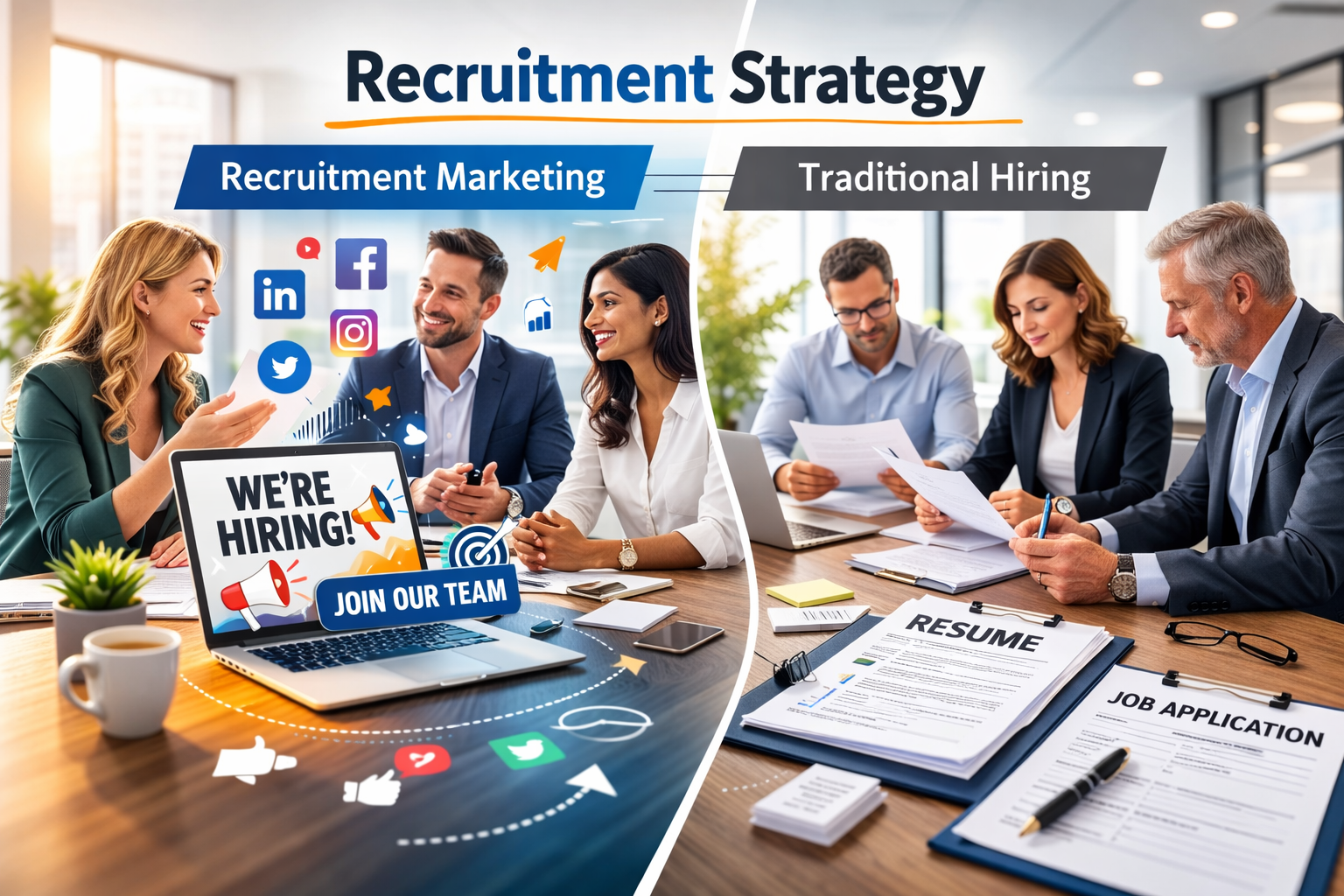
Hiring has changed dramatically over the past decade. Organizations are no longer competing only on salary or job titles. They are competing on culture, flexibility, growth opportunities, and brand reputation. Understanding recruitment marketing vs traditional hiring helps businesses choose the right strategy to attract stronger candidates and reduce hiring risks.
This guide explains both approaches in depth, compares their strengths, and helps you decide which method fits your company’s goals.
What Is Recruitment Marketing?
Recruitment marketing is a long term strategy focused on promoting your company as an employer before you have open roles. Instead of reacting to vacancies, businesses build relationships with potential candidates over time.
It combines employer branding, content strategy, and candidate engagement to create interest in future opportunities. Companies that already understand what a staffing agency is often see how structured recruitment systems support long term talent attraction beyond immediate job postings.
Key Elements of Recruitment Marketing
- Employer branding in recruitment
- Social media recruiting
- Talent community building
- Recruitment campaigns
- Passive candidate outreach
- Long term talent acquisition pipeline development
Recruitment marketing works similarly to customer marketing. Instead of selling a product, you communicate why your workplace is worth joining. Companies share employee stories, culture insights, leadership values, and career growth paths to build trust.
Why Recruitment Marketing Matters
Companies that invest in recruitment marketing often experience:
- Stronger candidate quality
- Reduced time to hire
- Higher offer acceptance rates
- Better cultural alignment
- Improved long term retention
What Is Traditional Hiring?
The traditional hiring process begins when there is an open position. It focuses on filling an immediate vacancy through job advertisements and resume screening.
Common Steps in Traditional Recruitment
- Post job advertisement
- Collect applications
- Screen resumes
- Conduct interviews
- Make an offer
- Onboard the candidate
Traditional recruitment methods are reactive. They address current workforce gaps rather than anticipating future hiring needs.
When companies evaluate workforce strategy decisions like internal vs external hiring, they often realize how traditional hiring tends to prioritize external applicants after a vacancy appears.
When Traditional Hiring Works Best
- Urgent hiring needs
- Entry level or high volume roles
- Small businesses with limited recruitment budgets
- Short term workforce gaps
It remains a reliable method, especially when speed is the primary objective.
Recruitment Marketing vs Traditional Hiring: Core Differences
Below is a clear comparison to understand how these strategies differ.
| Factor | Recruitment Marketing | Traditional Hiring |
|---|---|---|
| Approach | Proactive | Reactive |
| Focus | Long term workforce planning | Immediate vacancy filling |
| Candidate Type | Active + Passive candidates | Mainly active job seekers |
| Branding | Strong employer branding emphasis | Role focused messaging |
| Talent Pipeline | Built continuously | Built after job posting |
| Technology Use | Marketing tools + analytics | Applicant tracking systems |
The main difference is mindset. Recruitment marketing prepares for future needs, while traditional hiring responds to present ones.
Proactive vs Reactive Hiring Strategy
Recruitment marketing is proactive. It targets both active and passive candidates and nurtures relationships before roles become available. This approach reduces rushed hiring decisions and improves candidate quality.
Traditional hiring is reactive. It depends on applicants responding to job advertisements after a role is posted. While effective in certain cases, it can increase the risk of rushed decisions that sometimes lead to costly HR mistakes.
In competitive industries, proactive strategies often produce stronger hiring outcomes.
The Role of Employer Branding in Recruitment
Employer branding plays a central role in recruitment marketing. Instead of simply listing qualifications, companies highlight:
- Company mission and values
- Workplace culture
- Career development opportunities
- Leadership transparency
- Employee success stories
Strong branding attracts candidates who align with organizational culture, improving retention and engagement.
Traditional job advertisements usually emphasize responsibilities, skills, and salary. While clear, they may not communicate long term career potential.
Technology and Hiring Metrics
Both approaches use technology, but recruitment marketing expands its application.
Traditional hiring tools typically include applicant tracking systems and resume databases. Recruitment marketing integrates marketing automation tools, analytics platforms, and candidate relationship management systems.
Companies that want stronger hiring efficiency sometimes explore the benefits of outsourcing the recruitment process to combine advanced tools with expert strategy.
Tracking hiring metrics such as time to hire, cost per hire, and offer acceptance rate helps businesses refine their recruitment systems continuously.
Benefits of Recruitment Marketing
Recruitment marketing provides long term strategic value.
- Builds a consistent talent pipeline
- Reduces future hiring pressure
- Improves employer visibility
- Attracts higher quality passive candidates
- Strengthens candidate engagement
- Supports workforce planning
Although it may require planning and coordination, it often reduces overall recruitment costs over time.
Benefits of Traditional Hiring
Traditional recruitment remains relevant and practical in many scenarios.
- Quick implementation
- Familiar processes for HR teams
- Lower upfront planning requirements
- Effective for urgent or entry level roles
- Straightforward execution
For companies with occasional hiring needs, this method may be sufficient.
When Should You Use Each Approach?
The right strategy depends on several factors:
Company Size
- Large organizations benefit from recruitment marketing due to ongoing hiring needs.
- Small businesses may prioritize traditional hiring with occasional branding efforts.
Industry Competition
- Competitive industries require proactive talent attraction.
- Less competitive markets may fill roles quickly through job boards.
Position Level
- Executive and specialized roles often need proactive sourcing.
- Entry level roles may fill effectively through traditional postings.
The Hybrid Hiring Model: Best of Both Worlds
Many companies now combine both approaches. They build employer brand awareness year round while also posting roles traditionally when vacancies arise.
Example hybrid strategy:
- Maintain active social media recruiting content
- Build a passive candidate database
- Post jobs on relevant platforms when roles open
- Contact pre engaged candidates directly
This balanced approach increases reach, improves hiring metrics, and strengthens long term talent acquisition.
Common Hiring Mistakes to Avoid
Regardless of strategy, avoid these common issues:
- Ignoring employer branding
- Rushing hiring decisions
- Focusing only on active candidates
- Failing to track hiring metrics
- Overlooking candidate experience
Successful hiring requires structure, data, and consistent communication.
Final Thoughts
Recruitment marketing vs traditional hiring is not about choosing one method permanently. It is about understanding your organization’s goals, hiring frequency, and growth strategy.
Traditional hiring solves immediate staffing needs. Recruitment marketing builds sustainable workforce strength.
Companies that align their hiring strategy with long term planning, employer branding, and proactive candidate engagement are better positioned to attract skilled professionals and achieve steady growth.
If your business aims to improve talent acquisition results, consider integrating both strategies for stronger and more reliable hiring outcomes.
Frequently Asked Questions
What is the main difference between recruitment marketing and traditional hiring?
Recruitment marketing is proactive and brand focused. Traditional hiring reacts to open roles.
Which approach is better for finding passive candidates?
Recruitment marketing is better for engaging passive candidates through ongoing outreach.
Can small businesses benefit from recruitment marketing?
Yes, even simple employer branding efforts can improve visibility and talent pipelines.
How does recruitment marketing improve candidate engagement?
It builds connection through branding, content, and consistent communication before applications.
Do traditional hiring methods still work in today’s market?
Yes, especially for urgent or entry level positions.
How do I implement recruitment marketing alongside traditional hiring?
Start with employer branding content and candidate outreach while continuing to use job postings and applicant tracking systems